Wellness Tips
What Your DEXA Scan Doesn't Tell You About Your Fracture Risk
A DEXA scan can tell you how dense your bones are, but it can’t tell the whole story about your risk of breaking one. Dr. Jen explains why fractures often happen in women whose T-score doesn’t meet the definition of osteoporosis, how FRAX adds crucial context, and why both numbers matter when you're thinking about bone health after 50.
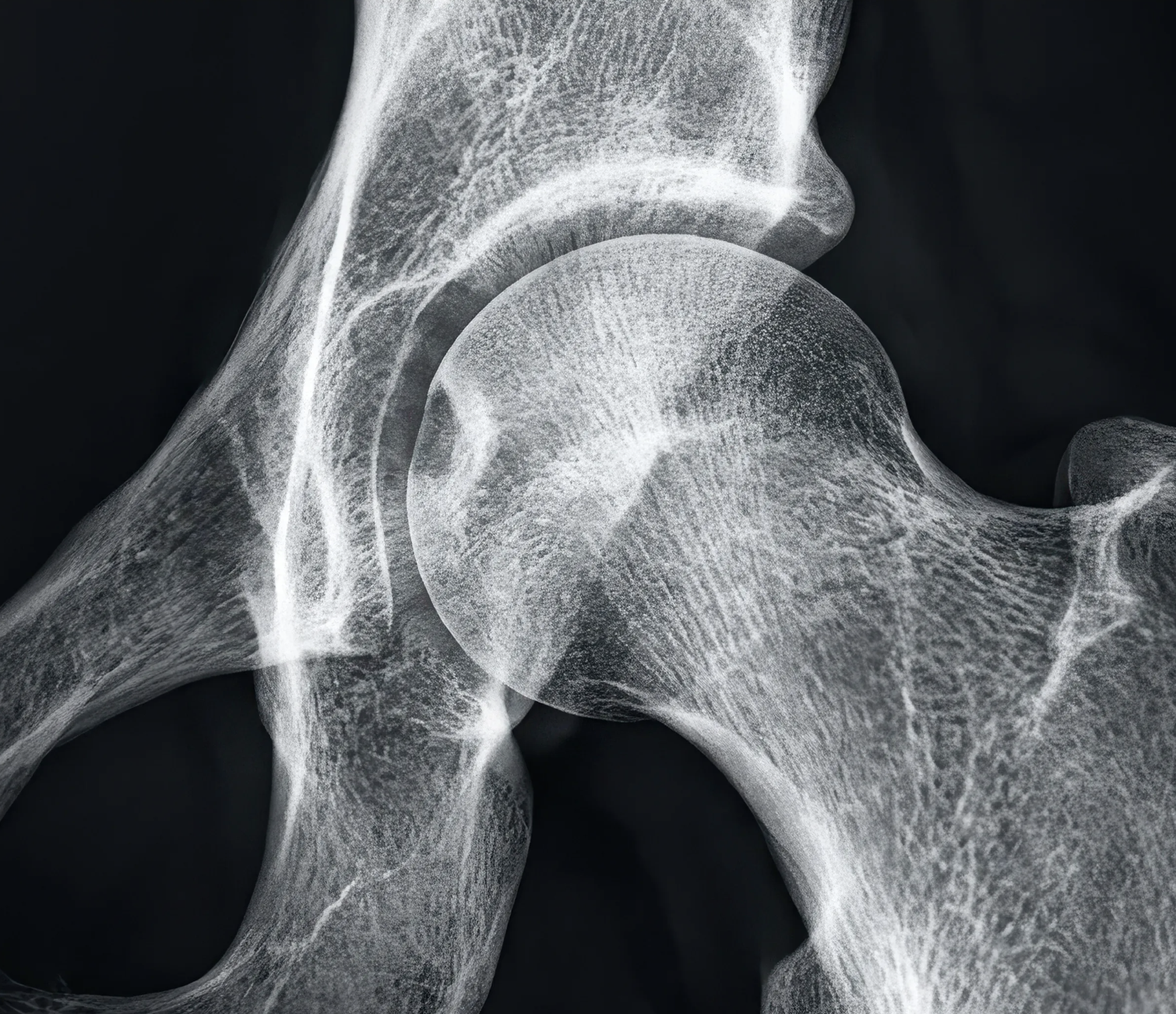
If you’ve had a DEXA scan, you probably remember the number. Maybe it was -1.4. Maybe -2.2. Maybe you crossed the dreaded -2.5 line and suddenly heard the word osteoporosis.
But here’s something I think every woman over 50 should understand about bone density: Approximately 70% of osteoporotic fractures occur in people who do NOT meet the T-score definition of osteoporosis. Most fractures happen in people whose T-score is above -2.5.
Read that again.
DEXA, technically DXA, is an incredibly useful test. It measures bone mineral density, usually at the hip and spine, and remains our standard clinical tool for diagnosing osteoporosis and monitoring bone health. But your T-score is not a report card on whether your bones are “good” or “bad,” and it definitely doesn’t tell us everything about whether or not you’re going to break a bone.
One reason is how the T-score is calculated
Your T-score compares your bone density with the average peak bone density of a healthy young adult, essentially asking: How far are you from the bones of someone around age 20 to 30? A score of -2.5 or lower meets the densitometric definition of osteoporosis. This young adult comparison is intentional because it gives us a way to quantify cumulative bone loss. But, obviously, comparing the bones of a 70-year-old woman with those of a 25-year-old has limitations.
There’s another number called the Z-score, which compares your bone density with people of similar age and sex. For postmenopausal women, we generally use the T-score for diagnosis. Z-scores become particularly useful in younger people and can also provide context when bone density seems unusually low for someone's age.
The bigger issue is that fracture risk exists on a continuum. There’s nothing magical that happens biologically when your T-score goes from -2.4 to -2.5. With every standard-deviation decline in bone mineral density, fracture risk rises—but age matters enormously too. A 55-year-old and an 80-year-old with identical T-scores do not have identical fracture risks.
This is why I never want women focusing on the DEXA number alone.
We also need to consider whether you have already had a fragility fracture, your age, family history of hip fracture, smoking, alcohol use, certain medications such as long-term steroids, body weight, and other medical conditions. A previous fragility fracture can even establish osteoporosis clinically despite a T-score above -2.5.
That’s where FRAX comes in
FRAX stands for Fracture Risk Assessment Tool. FRAX combines bone density with clinical risk factors to estimate two things: your 10-year probability of a hip fracture and your 10-year probability of a major osteoporotic fracture, meaning a fracture of the hip, clinical spine, forearm, or shoulder.
For women with osteopenia, that calculation can sometimes be far more clinically meaningful than the word “osteopenia” itself. If you know your recent T-score from your DEXA, you can calculate your FRAX score yourself using the official FRAX calculator. I actually think this is a useful exercise, particularly after age 50.
The calculation uses age, sex, height, and weight, plus several clinical risk factors: prior fracture, a parent with a hip fracture, current smoking, glucocorticoid use, rheumatoid arthritis, secondary causes of osteoporosis, and drinking three or more units of alcohol per day. It can also incorporate femoral-neck bone mineral density from your DEXA scan, which improves risk characterization when it’s available.
A few important caveats: FRAX is not a blood test or another scan. It’s a mathematical risk calculator. And it doesn’t capture everything that matters. For example, it doesn’t fully account for fall risk, the number and recency of previous fractures, the dose of steroids someone takes, or all aspects of bone quality. The standard FRAX calculation specifically uses femoral-neck BMD, not the lumbar-spine T-score.
This is why I would use FRAX as a conversation starter rather than a self-diagnosis tool. You may discover that your DEXA says “osteopenia,” which sounds relatively reassuring, but your age and clinical risk factors produce a meaningful 10-year fracture probability. Conversely, two women with the exact same T-score can have very different FRAX scores.
The bottom line on these two tests
DEXA tells you how dense your bones are. FRAX helps answer the question you actually care about: How likely am I to break one?
DEXA does have limitations you should know about. Arthritis and degenerative changes in the spine can artificially elevate measured bone density. Results can vary somewhat between machines, which is why I prefer repeat studies on the same equipment whenever possible. And bone density measures primarily how much mineral is there, not every aspect of bone quality or architecture. Tools such as trabecular bone score can sometimes add another layer of information.
So get the DEXA. I recommend doing so when you enter menopause, NOT waiting until 65, which is the national guideline. Know your T-score. Calculate your FRAX score and track them over time.
LEARN HOW TO INCREASE BONE DENSITY