Fitness Guides
5 Different Ways to Test Your Body Fat Composition
If you’ve ever watched your body fat percentage swing wildly on a “smart” scale, you’re not alone. Here’s how the most common body composition tests stack up — and which ones actually matter after menopause.
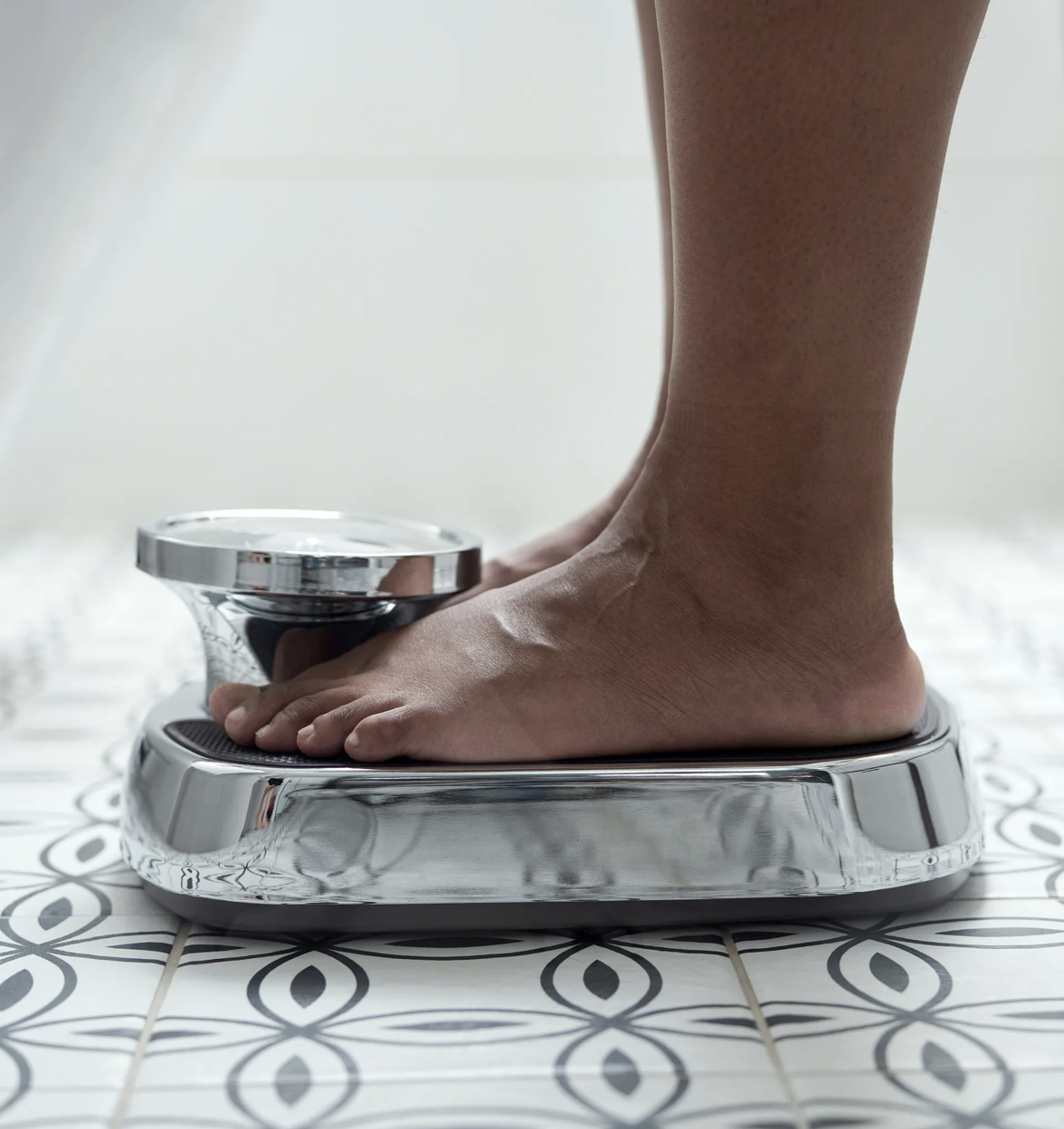
Ever stepped on a “smart” scale and watched your body fat percentage jump around like the stock market? I’ve been there. There’s so much happening inside our bodies, from where fat is stored to how much muscle we have to bone strength. It’s never just a number on a scale.
And menopause makes it that much harder to track. More central fat, less total body water, and gradual muscle loss if you’re not strength training.
Fortunately, a bathroom scale isn’t the only option. I am asked all the time if these various body composition devices are “worth it.” Let’s go through the major body comp test methods.
1) Bathroom “body fat” scales (single-frequency BIA)
This is the scale you probably already have in your bathroom. They use bioelectrical impedance analysis (BIA): a small current travels through your body, and the device estimates fat mass vs lean mass based largely on how water conducts electricity.
Sounds simple. The problem is that almost everything affects water.
Had a glass of wine last night? Different reading. Went for a run this morning? Different reading. Ate salty food, took a hot shower, or flew across the country? All different readings. And after 50, the margin of error gets wider:
- Zoom In: Menopause shifts where we store fat and how much water our bodies hold, which means these scales can be even less reliable than they were in our 30s.
Research shows that while BIA scales can track trends, they often diverge from the gold-standard DEXA scan and have meaningful individual-level error and bias.
- Pros: cheap, easy, great for trend tracking if you standardize conditions
- Cons: not “precise”; day-to-day numbers are often more drama than data
- Cost: $30–$200
2) Gym/clinic segmental, multi-frequency BIA (InBody-style)
These are the machines you've seen at your gym or doctor's office, where you stand barefoot on metal plates and grip handles while it does its thing (e.g., the InBody Machine).
Unlike the scale at home, these devices measure electrical impedance across different body segments (arms, legs, trunk) and different body components (bone, fat, muscle, water) and use multiple frequencies.
They’re generally better than bathroom scales, and in older adults, some models show improved agreement with DXA (still not perfect).
- Pros: fast, repeatable, useful for tracking muscle distribution over time
- Cons: still hydration-sensitive, still an estimate
- Cost: often $10–$40 per scan in gyms or wellness settings. The machine itself runs over $6000.
3) DEXA body composition
DEXA (dual-energy X-ray absorptiometry) is the “gold standard.” It measures bone, lean mass, and fat mass with high precision. Lost two pounds? DEXA tells you whether it was muscle or fat. Strength training for six months? DEXA shows whether your bones have strengthened.
It’s not perfect (different machines and software can vary), but if you use the same machine, it’s excellent for tracking change.
- Pros: best balance of accuracy + practicality; also gives bone data
- Cons: cost and access; low-dose radiation. Also, many technicians flat out refuse to run this (generally because they may not be aware that it can easily be done while testing bone density and it’s just easier for them to say ‘no.’)
- Cost: roughly $40–$300+ cash-pay depending on setting
4) Bod Pod (air displacement plethysmography)
This “egg-shaped” chamber estimates body fat based on body volume and density. It looks futuristic, feels a little claustrophobic, and…isn’t as accurate as you’d hope.
Research shows the Bod Pod can over- or underestimate compared to DEXA, with bias depending on your body size and shape.
- Pros: quick, noninvasive
- Cons: results can differ from DXA; sensitive to protocol and clothing
- Typical cost: $30–$100
5) Skinfold calipers
The old school pinch test. A technician uses calipers to measure fat at specific spots on your body, plugs those numbers into an equation, and estimates your body fat percentage.
Can it work? Sometimes. But accuracy depends heavily on the measurer and the equation. In older adults, certain equations perform better than others, and some are simply unreliable.
- Pros: inexpensive, portable
- Cons: technician-dependent; less accurate with age-related fat redistribution
- Typical cost: ~$20–$75 for an assessment
My North Star Takeaway
Don’t obsess over a single number on your bathroom scale. Use it for trends only, under the same conditions, and focus on what moves the needle: strength, protein, sleep, and mobility.
And if you want hard data? Go with DEXA. (Or if that's not accessible, find a multi-frequency BIA machine and use the same one every time.) That's how you build your own dataset and use it to make smarter decisions about your health.
The number is just information. What you do with it is what counts.