Fitness Guides
The 5-Minute Habit Worth Starting This Week
Flexibility becomes increasingly important as we age, particularly for women navigating menopause. Dr. Jen explores the connection between flexibility, musculoskeletal changes, mobility, and healthy aging—and shares simple ways to make stretching a practical part of your self-care routine.
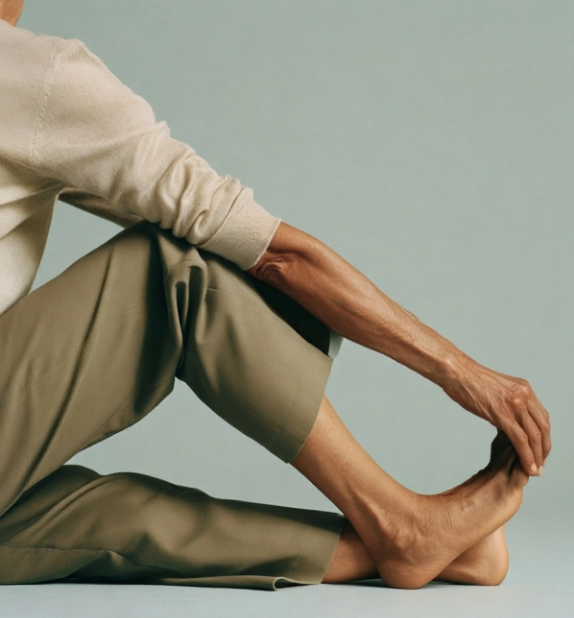
There’s one week left of Self-Care Awareness Month, and, boy, do I have an idea for you to make it count: Stretching!
I say that as someone who has never liked stretching. I’ve always dreaded it and didn’t really think it was necessary. However, the research has made me feel a little foolish for that, especially now that I’m over 50.
Flexibility is not a “nice to have”
In 2024, researchers in the Scandinavian Journal of Medicine & Science in Sports scored the range of motion of more than 3,000 adults aged 46 to 65 and then followed them for over a decade. Women with the lowest flexibility scores had close to five times the risk of dying during follow-up compared with the most flexible women, after accounting for age, BMI, and health status. DYING! That is an association, not causation and certainly not proof that stretching itself buys you years. Flexibility may simply be a marker of how much you move, how well you balance, and how likely you are to stay upright. But the gap for women was far wider than for men, and that is worth our attention.
The stiffness is real, and it’s not in your head
In 2024, a paper in the journal Climacteric gave a name to something most of us have been describing for years: the musculoskeletal syndrome of menopause. Orthopedist Dr. Vonda Wright was one of the first doctors to describe this and actually connect the dots to a hormonal change that we experience. More than 70% of women develop musculoskeletal symptoms through the transition, and roughly a quarter are significantly disabled by them. Estrogen receptors sit in your cartilage, tendons, ligaments, and muscle, so the morning stiffness and the shoulder that no longer reaches the top shelf have an actual mechanism behind them. You are not imagining it, and you are not simply out of shape.
How to start this week
Anything is better than nothing. Aim for five minutes, three days. Stretch warm tissue, so after a walk or a shower, not cold out of bed. Working your way from head to toe, hold each position for about 30 seconds. The areas that matter most after 50? Hip flexors, hamstrings, calves, plantar fascia, and the thoracic spine and shoulders.
If you truly hate stretching, you have an out. A meta-analysis in Sports Medicine found that resistance training can improve range of motion about as effectively as stretch training, which means full-depth squats and full-range presses may count toward the same goal. Choose the version you will actually do. And, of course, it’s not either/or. You can and should do both. Trust me when I tell you, you WILL feel better!
For a baseline, try the Sitting-Rising Test: Sit on the floor and stand back up without using your hands. Note what that felt like today, then try again after a month of daily stretching.
One more thing. If a single joint, like your shoulder, has lost range over weeks rather than years, say this to your doctor: "I have lost range of motion in this shoulder and I want to know whether this is adhesive capsulitis." Frozen shoulder responds far better when it’s caught early.
The bottom line
Stretching is self-care and it’s worth taking five minutes out of your day for—especially if you’re a woman over 50. This practice can help prevent injuries and release endorphins, and it’s completely free.