Fitness Guides
The Biggest Fitness Myth Over 50 The Fitness Industry Doesn't Want You to Know About
There is no single “perfect” workout after 50. The body requires a combination of strength, cardio, mobility, balance, and recovery—and focusing on just one leaves critical gaps.
There is a fitness myth I keep seeing everywhere, and it makes me nuts because it sounds so believable. It’s the idea that there is one perfect workout. One class, one machine, one method, one “secret” that is going to solve everything after 50.
And to be fair, I understand why we want that to be true. We are all busy. We are tired of being told we need to do more and just want a clear answer. We want someone credible to say, “This is the thing. Do this, and you’re good.” Walking. Pilates. Strength training. Yoga. Zone 2 cardio. HIIT. Barre. Pickleball. Whatever the current favorite fad happens to be…
But here’s the problem: almost every one of those things is good for you, BUT actually none of them is enough by itself.
That’s the part the fitness industry does not love to say out loud, because “do this one thing” is much easier to package and sell than “your body is complex and needs different types of stress, challenge, and recovery.” But over 50, this really matters. Variety is not just nice to have, it is physiological.
Your body is not one system; it is many systems working together. Your muscles need resistance. Your heart needs endurance and intensity. Your joints need mobility. Your tendons and ligaments need gradual loading. Your bones need impact or force. Your nervous system needs balance and coordination. Your brain needs novelty and challenge. And your body needs recovery, which, somehow, still feels like the least glamorous wellness advice ever, even though it may be one of the most important.
This is where I think a lot of very disciplined, very health-conscious women get frustrated. They are active, consistent, and they are doing “the right thing.” But often, the right thing they’re doing is actually one thing done over and over again.
A woman who walks 10k steps every day is wonderful, but she never lifts enough weight to truly challenge her muscles. Another woman lifts weights, but avoids cardio because she hates it or because someone convinced her cardio was “bad for cortisol” (which is not true by the way). Someone else does Pilates three times a week and has a beautiful core, but never trains her heart rate. Another does high-intensity cardio, but never stretches, never works on balance or strength, and wonders why her hips feel like they belong to someone else. And then there is the woman who plays tennis or pickleball and thinks that counts as everything, until her calf, Achilles, shoulder, knee, or lower back files a formal complaint.
I say this with love because I have done versions of this myself. We all have. We find what we like, what we’re good at, what fits into our schedule, what makes us feel competent, and then we cling to it. The problem is that after 50, the body becomes much less tolerant of missing categories.
That is not meant to be depressing. It is meant to be clarifying.
In our 20s and 30s, many of us could get away with doing random exercise and still feel pretty good. A run here, a yoga class there, a few weeks of being “good,” and our bodies responded. But in midlife and beyond, especially around menopause and after it, the margin changes.
- Muscle becomes harder to build and easier to lose.
- Power declines faster than we think.
- Balance can slip quietly.
- Tendons become less forgiving.
- Cardiovascular fitness can fade unless we train it deliberately.
- Range of motion gets smaller if we don’t keep asking for it.
So the question is not, “What is the best workout for women over 50?” The better question is, “What am I missing?”
That one question can change everything.
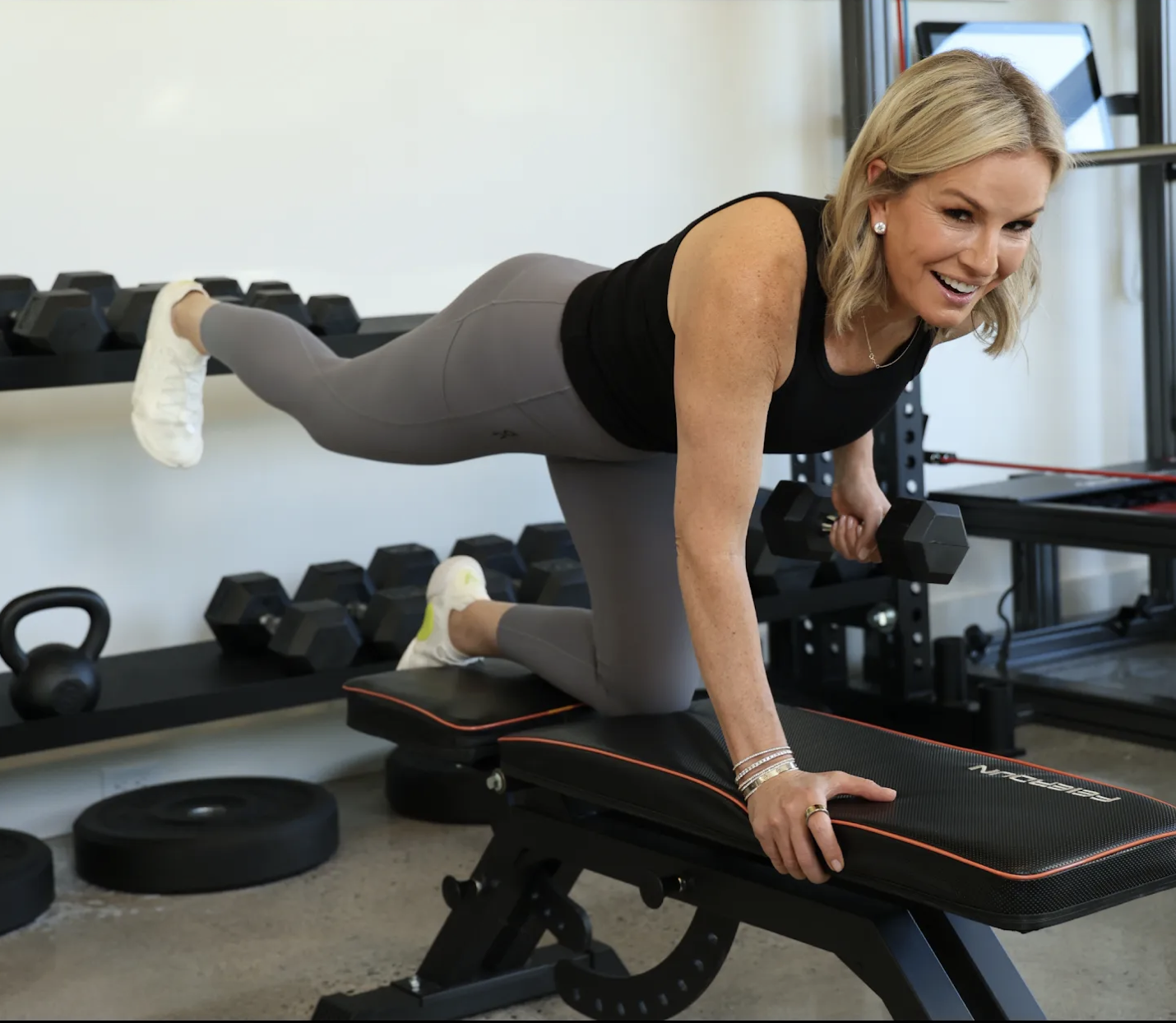
A smart fitness routine after 50 needs strength training, ideally three times a week, because muscle is not just about looking toned. Muscle is metabolic tissue. It helps with glucose regulation, joint stability, posture, bone health, and independence. It is what helps you lift your suitcase into the overhead bin without making a noise that scares the person in 12C.
It also needs cardiovascular training, and not just one speed. Easy cardio matters. Walking matters. Zone 2 matters. But if it is safe and appropriate for you, your heart also needs higher-intensity work. You need enough to remind your cardiovascular system that it can work hard and recover. This means the assault bike, treadmill sprints, rower sprints, any sprint interval training, stuff that feels super unpleasant but delivers extraordinary results.
Then there is mobility and flexibility, which I used to think of as the thing you do at the end if there is time, which of course means never. But hips, shoulders, ankles, and the spine all need attention. Strength without range of motion is limited. Mobility without strength is also limited. We need both.
Balance deserves its own category, even though it is probably the least sexy fitness word in the English language. But balance is strength, coordination, brain training, and fall prevention all rolled into one. And it is much better to train it in your living room than to find out you needed it while stepping off a curb in cute shoes.
And finally, recovery has to be part of the plan. Not because we are fragile, but because adaptation happens when the body has a chance to repair. Sleep, protein, hydration, rest days, easier movement days, all of that counts. Recovery is not the opposite of training. It is part of the training.
So no, I am not here to tell you that walking is bad, or Pilates is overrated, or strength training is the only thing that matters, or cardio is the enemy, or yoga is not enough. That is not the point.
The point is that any one of them, alone, leaves gaps and is definitely not enough.
If you love walking, please keep walking. Just add strength. If you love lifting, keep lifting. Just add cardio and mobility. If you love Pilates, keep doing Pilates. Just add heavier resistance and some heart-rate work. If you love yoga, keep doing yoga. Just add load and power. If you love pickleball, I am thrilled for your social life, but stretch your calves and train your balance.
This is not about doing more for the sake of doing more. It is about being more complete and more holistic in how we care for the body we have now.
Over 50, the goal is not just to be thinner, smaller, or “good” at exercise. The goal is to be strong enough, steady enough, mobile enough, and fit enough to live your life with confidence. To carry things, climb the stairs, play on the floor with babies and small children, travel, recover from setbacks, avoid preventable injuries, and feel capable in your own body.
There is no single magic workout. Not Barry’s, not Bar Method, not Hot Yoga, not SLT or PVOLVE, or SoulCycle or Orange Theory… It’s not either/or. It’s EVERYTHING. Which is why I want us all to have the wisdom to stop giving a complex system only one overly simplistic answer.