Healthy Living
What's Actually in Your Bed
Most conversations about sleep focus on supplements, blue light, or bedtime routines. But some of the biggest factors affecting your sleep may already be sharing your bed—or your bedroom. From snoring partners to pets and room temperature, here's what the research says about creating a sleep environment that truly supports restorative rest.
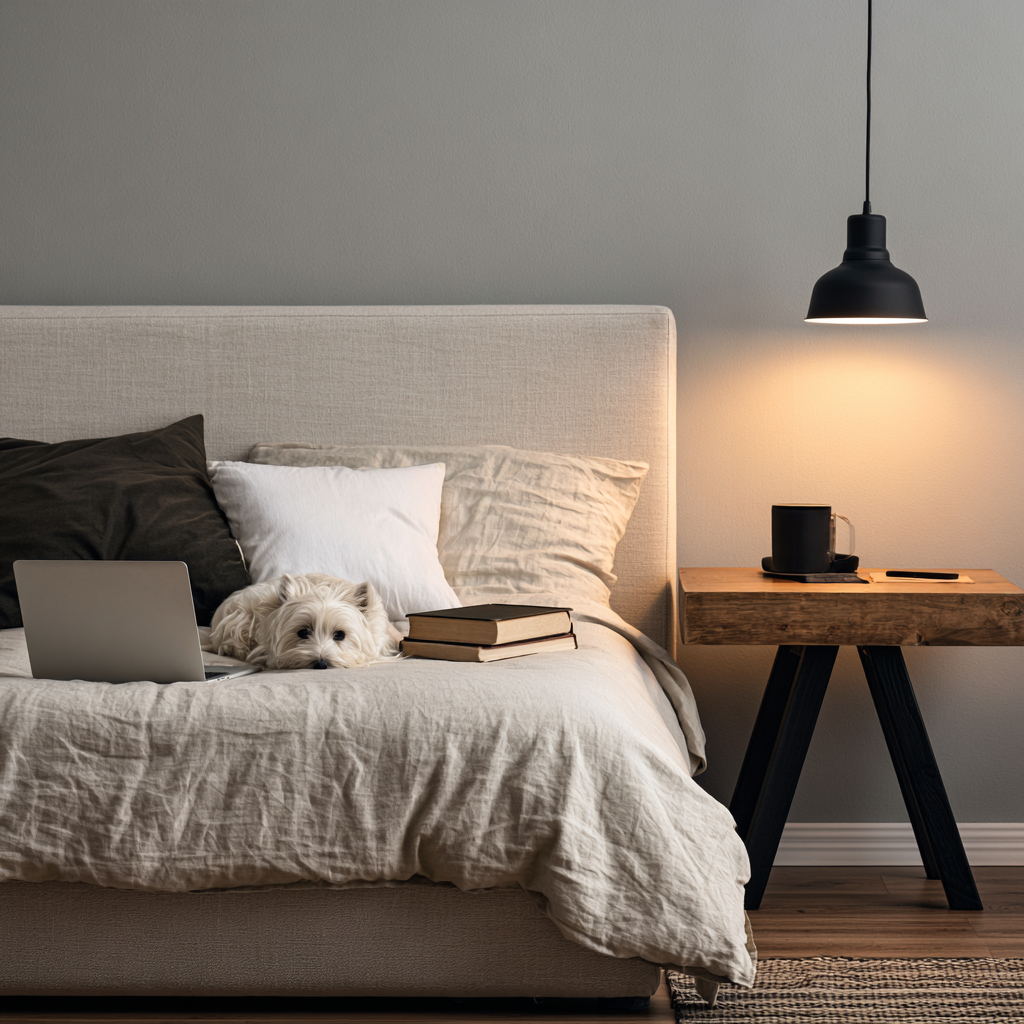
Let's do an inventory. Tonight, before you turn out the light, count what's in the bed with you. A partner or spouse, a dog, possibly two, perhaps a cat who has designated your hip as her permanent address, maybe a laptop, book, or (gulp) cellphone?!
We spend enormous energy on sleep at the margins: the supplements, the tracker, the app that tells us what we already knew… that we slept badly. Meanwhile, the biggest variables in the room are the ones breathing next to us and we treat them as permanent features of the landscape. They are not permanent. They are the most changeable things we have.
I'll go first. Mason, all nine pounds of him, sleeps curled in a tight ball between us every single night. We call him the “cinnamon roll.” He’s occasionally the reason I wake at 2 a.m. inexplicably overheated as I’ve found him spooning his little body directly against mine, which is a remarkable achievement for an animal roughly the size of a roast chicken. He’s also, I'll admit it, calming in a way I can't argue with. So none of what follows comes from a position of moral authority. I'm writing this from the same bed you are.
The snorer
Start here, because it's the largest effect and the one women are least willing to touch.
The American Academy of Sleep Medicine found that more than a third of American adults occasionally or consistently sleep in another room to escape a partner's snoring, restlessness, or schedule. But look at who: 45% of men do it, compared with 25% of women, and boomers come in last of any generation at 22%. So the woman most likely to be losing sleep to a snorer is also the least likely to be the one who leaves the room.
Let me say this plainly: Sleeping in separate rooms is not a referendum on your marriage. It’s a decision about decibels and health. Among people who've made the switch, roughly half report better sleep quality, gaining around 37 minutes a night. That’s the difference between six and a half hours and seven.
And the medical piece, which is not optional, is critically important. If your partner’s snoring comes with gasping, choking, or pauses in breathing, that’s a screen for obstructive sleep apnea and they need an evaluation. Untreated apnea is a cardiovascular problem, not a personality quirk. While you're at it, consider getting yourself evaluated. Apnea in women is badly underdiagnosed, partly because we show up with fatigue and insomnia rather than the loud, classic snoring, and risk climbs after menopause.
The dog
Now the harder conversation, and I know it's harder, because nobody has ever gotten defensive with me about a thermostat.
Mayo Clinic researchers actually measured this, putting activity monitors on both the human and dog subjects for a week. People who slept with a dog in the bedroom, but not on the bed, held about 83% sleep efficiency, which is solid. Those with their dog on the bed dropped to roughly 80% and woke more often during the night. Personally, I disagree with this finding and I’ve also seen studies that suggest that we sleep better with our fur baby in our bed.
Here’s my honest read. Three points of a sleep efficiency scale is a real cost—and if you’re already sleeping badly, it’s a cost you can’t afford and the dog goes on the floor. But if you're sleeping reasonably well and that animal is the reason you feel safe in a house that got quiet a few years ago, I’m not going to tell you the data says evict her. The data says you're paying a small toll. You decide whether it's worth it.
For the record, Mason stays.
The temperature
Aim for 65 to 68°F. Your core temperature has to fall for you to fall asleep and stay asleep, and a warm room blocks that.
If you're in menopause, you already know this room is a battlefield, and it's usually a battlefield because two people with wildly different thermostats are sharing one blanket. (I believe the one in menopause should win, by the way.) The fix is not a compromise temperature that leaves you both miserable. Set the room cool and separate the bedding: two twin duvets on one bed, Scandinavian style. It solves the temperature mismatch and the cover-stealing in a single move. Or, invest in one of the sleep mattress temperature systems. I’m currently testing one out, and will have more to report on this soon. I tried one last year for a few days and really liked it!
How to actually test this
Change one variable. Keep it for two weeks. Every morning, write down a single number, one to ten, for how you feel. Not your tracker's score. Yours.
Week one, the dog sleeps on the floor. Week three, the thermostat goes to 66. Week five, separate duvets. One at a time, or you learn nothing.
The most important step
The most effective sleep intervention available to most women over 50 costs nothing, requires no prescription, and involves one uncomfortable conversation with the person lying next to you. Have the conversation and prioritize your sleep. Trust me—it really does matter.