Wellness Resources
Worth it or Waste: Red Light Therapy for Hair Thinning
Red light therapy for hair thinning is not magic, but it is not nonsense either. Emerging evidence suggests it may help improve hair density in women with pattern hair loss, especially when combined with proven treatments and used consistently over time.
Hair thinning is one of those topics that sounds cosmetic until it happens to you. Then suddenly it is not cosmetic at all. It’s emotional, and it’s personal. It’s the ponytail that feels smaller, the part that looks wider, the shower drain that looks more dramatic than it should, and the tiny internal panic of, “Wait, is this just aging, and when will this stop?”
For women over 50, hair thinning is common, but that does not mean it is simple. Female-pattern hair loss increases with age and is influenced by genetics, hormones, health conditions, nutrition, medications, stress, and time. Menopause can absolutely be part of the story, because estrogen has effects on the hair cycle, but we should be careful not to reduce every strand of hair on our head to “hormones.” Sometimes it is androgenetic alopecia. Sometimes it is telogen effluvium after illness, surgery, stress, weight loss, or a medication change. Sometimes it is iron deficiency, thyroid disease, inflammatory scalp disease, or a combination of all of the above.
So before we talk about red light therapy, let me say the unsexy doctor thing first: if your hair loss is sudden, patchy, associated with itching, pain, scaling, scarring, or major shedding, get evaluated. A board-certified dermatologist can help identify the type of hair loss, and that matters because the treatment depends on the diagnosis.
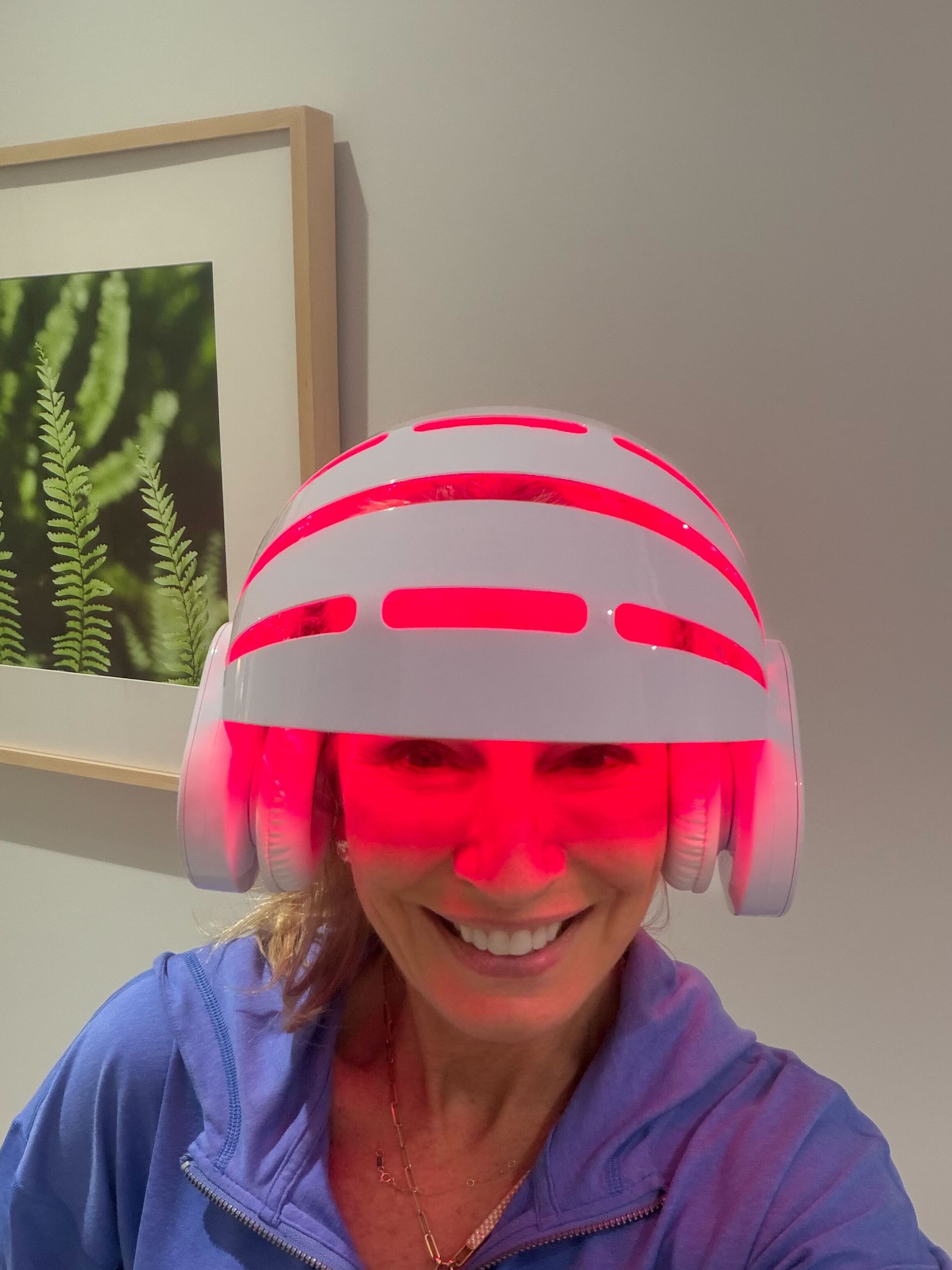
Now, red light therapy. Also called low-level light therapy, or LLLT, this is not the same as sitting under a red bulb and hoping for the best. Medical-grade devices use specific wavelengths of red or near-red light, often in caps, helmets, combs, or bands, intended to stimulate follicles. The proposed mechanism is that light may influence mitochondrial activity, increase blood flow around the follicle, reduce inflammation, and help shift follicles into the anagen, or growth, phase. That sounds very science-y, and it’s plausible. The question is whether it actually works.
The best answer is: yes, there is evidence it can help, especially for androgenetic alopecia, including female-pattern hair loss, but the effect is usually modest and requires consistency.
A 2025 systematic review and meta-analysis of low-level laser and LED therapy in alopecia included 38 studies with more than 3,000 patients and found significant improvement in hair density compared with placebo or sham treatment, especially in androgenetic alopecia. Earlier randomized, sham-controlled trials also found increases in terminal hair density in both men and women using low-level laser devices, with no serious adverse events reported in those studies. A 2021 systematic review of FDA-cleared home-use devices similarly found a significant increase in hair density with LLLT compared with sham, although the authors noted that the number of trials was limited and, importantly, devices varied widely. This is not a miracle. It’s not regrowing hair on a completely bald scalp. It’s not a replacement for diagnosing the cause of hair loss.
Most protocols require using the device several times per week for months. Some people may start to see changes around 12 to 16 weeks, but more meaningful results often take six months or longer. The real-world and trial data suggest that consistency matters. This is one of those treatments where buying the device and leaving it in the closet is, unfortunately, not considered a protocol.
For women over 50, the pros are real. Red light therapy is noninvasive, generally well tolerated, doesn’t have known systemic drug interactions, and can be used with other therapies like topical minoxidil. In fact, some studies suggest combination treatment with LLLT plus minoxidil may outperform either approach alone in female-pattern hair loss. For women who can’t tolerate minoxidil, don’t want oral medications, or want an adjunctive option, it can be reasonable.
But the cons are also real. Good devices are expensive, often hundreds to more than a thousand dollars. Insurance usually doesn’t cover them. The treatment schedule can be annoying, the results vary, and while the safety profile is reassuring, minor side effects such as scalp itching, tenderness, tingling, headache, or temporary shedding have been reported. The bigger issue isn’t danger; it’s expectation management.
There is also a regulatory nuance worth understanding. Many of these devices are FDA-cleared, not FDA-approved like a drug. FDA clearance through the 510(k) pathway generally means the device is considered substantially equivalent to a legally marketed predicate device. It doesn’t mean the FDA has evaluated it with the same efficacy standard used for prescription medications. FDA device summaries do list cleared indications for promoting hair growth in women with androgenetic alopecia, but that is not the same as saying every red light cap on the internet is equally effective.
My bottom line: red light therapy for hair thinning is not nonsense. It has biologic plausibility, published evidence, and a favorable safety profile. But it’s also not magic, not fast, not cheap, and not specifically proven for “menopausal hair loss” as its own distinct category. The evidence is mostly extrapolated from broader studies of pattern hair loss in men and women.
For a woman over 50, I would think of it as a reasonable adjunct, not the whole plan. First, know what type of hair loss you have. Second, address the basics: protein intake, iron and ferritin if indicated, thyroid status, medications, scalp health, stressors, and recent weight loss or illness. Third, discuss proven treatments like minoxidil with a dermatologist. And then, if you want to add red light therapy and can commit to the time and cost, I think it’s a fair, low-risk option.
It’s not a miracle helmet*, and not a scam by definition. More like a potentially useful tool, as long as we do the very boring, very grown-up thing first: diagnose the problem before buying the gadget. I personally use one, not terribly consistently, because it falls under the ‘may help and is very unlikely to hurt’ umbrella.