Wellness Tips
A Derm-Backed Hair Thickening Treatment You Can Do At Home
Hair thinning after 50 is common, biological, and often overlooked. Understanding what’s actually happening—and what treatments are worth your time—can change the conversation
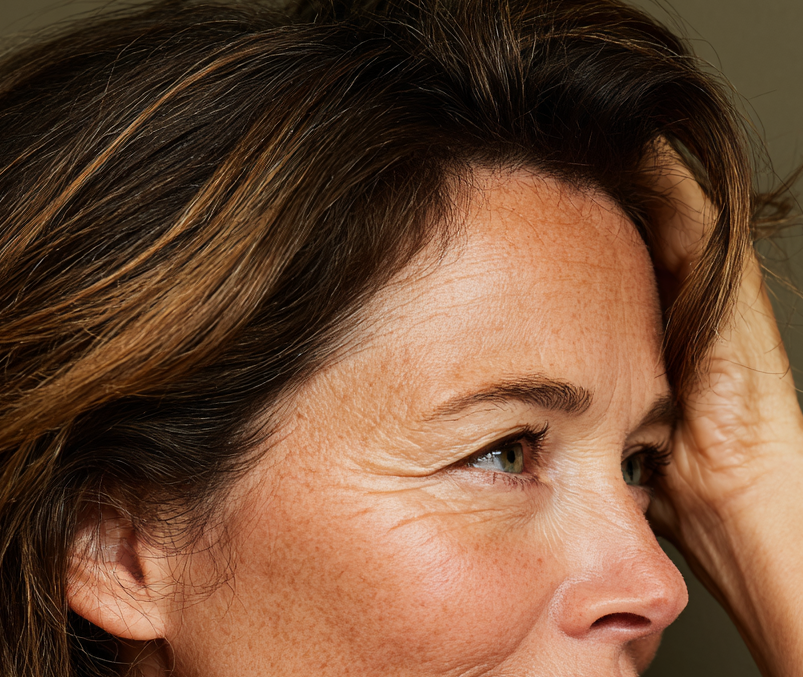
If you've found yourself angling your phone camera slightly higher lately, or parting your hair differently than you did five years ago, you're not imagining things. And you're not alone. I am living the thin-hair journey myself and have been for the past 5 years!
Hair thinning along the frontal hairline and crown is one of the most common and least discussed changes women experience after 50. It has a name: female pattern hair loss, or androgenetic alopecia. And the reason it tends to accelerate after menopause is straightforward. Estrogen and progesterone help keep hair in its growth phase longer. When those hormones decline, the growth phase shortens, the resting phase extends, and hair follicles miniaturize over time. What you're left with is hair that grows back finer, shorter, and less dense than before. This is biology, not neglect.
The other thing worth knowing: the frontal hairline is particularly vulnerable because follicles in that region tend to be more sensitive to androgens, specifically DHT, the testosterone derivative that shrinks follicles over time. After menopause, with estrogen's protective effect reduced, DHT has more room to operate.
So what actually works?
Topical minoxidil remains the most evidence-backed option we have. But there's a newer conversation happening around topical retinol, and the science is genuinely interesting. A study published in the Journal of the American Academy of Dermatology found that tretinoin, a prescription-strength retinoid, enhanced minoxidil absorption and improved hair regrowth outcomes when the two were used together. The theory is that retinoids upregulate growth factors in the scalp and improve cellular turnover around the follicle, creating a more receptive environment for regrowth.
At-home retinol use:
If you want to try topical retinol at home, start low and go slow. A 0.025% to 0.05% retinol applied to the scalp two to three nights per week is a reasonable starting point.
How to do it:
Apply it to a dry scalp, use sparingly along the hairline, and expect some initial dryness or irritation. Give it at least three to four months before drawing conclusions.
Other options:
Beyond retinol, the options worth discussing with your dermatologist include low-level laser therapy (LLT), which has solid trial data behind it, platelet-rich plasma injections, which are promising but still evolving, and oral minoxidil at low doses, which is gaining traction as an option for women who don't respond to topical treatment. (Note: I’m doing a deeper dive into red light therapy for thinning hair in an upcoming issue. Stay tuned!)
One thing I want to be direct about: hair loss in this population is under-treated because it's under-reported. Women don't mention it at appointments because they assume it's just aging. And physicians don't ask because it's not on the acute problem list. Bring it up, it's worth the conversation.