Fitness Guides
HIIT: What It Actually Looks Like, How to Do it, and Why the Cortisol Fear is Backwards
HIIT is one of the most misunderstood forms of exercise for women over 50. Here’s what the research actually says about intensity, cortisol, heart health, and how to structure interval training safely and effectively in midlife.
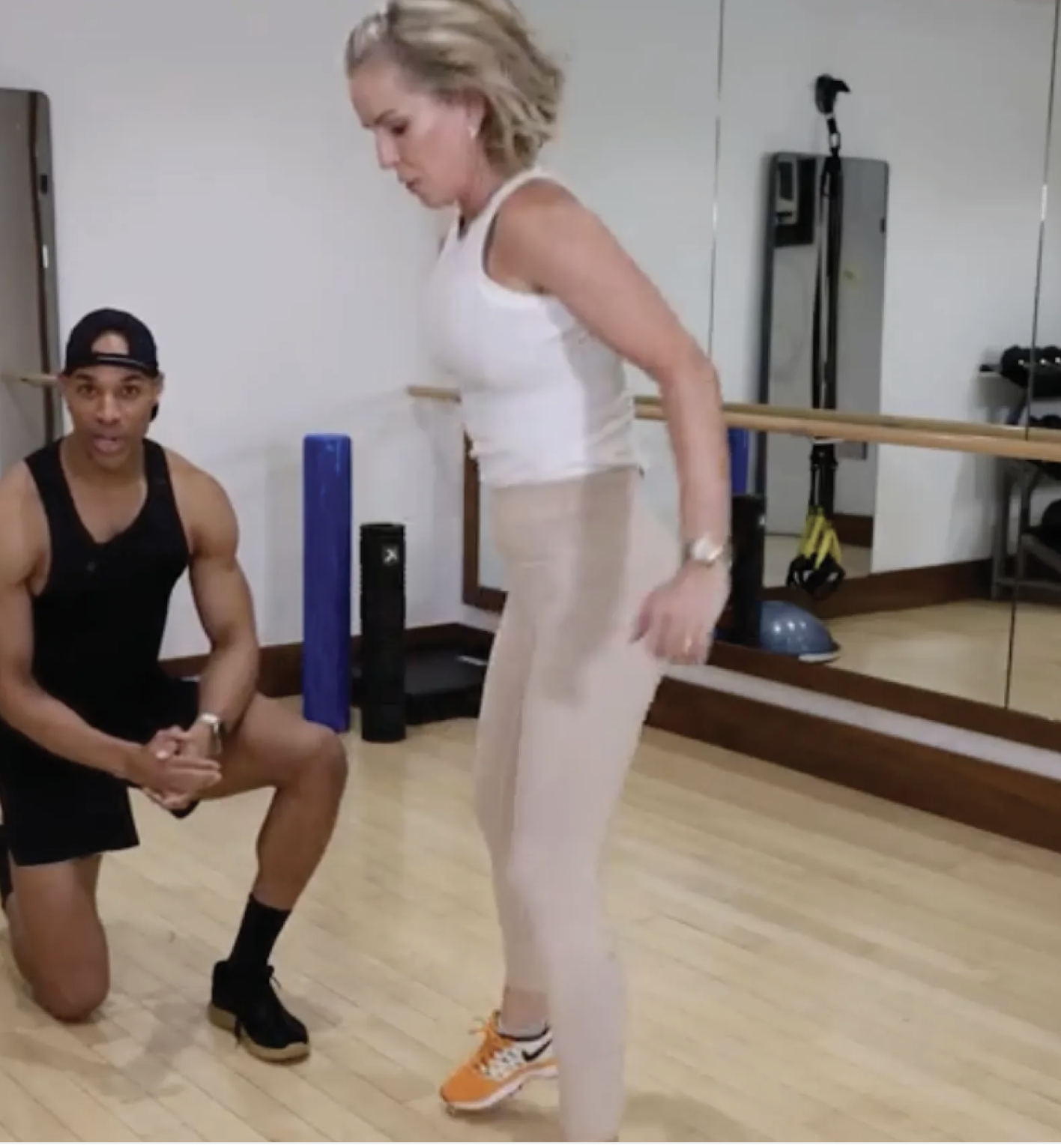
After my May 8th reel on women and cardio and a recap of a study I recently read, my DMs turned into a full Q&A session. So let me get specific, because "do HIIT" is not a prescription. It's a bumper sticker. Here's what it actually means in practice.
What HIIT is (and isn't)
High-intensity interval training means alternating short bursts of all-out or near-maximal effort with periods of lower-intensity recovery. The keyword is intensity. If you can comfortably hold a conversation during your "hard" interval, it's not HIIT. It's closer to cardio with enthusiasm. True HIIT means working at 80 to 95% of your maximum heart rate during the effort intervals.
How to calculate your target
A simple estimate of your max heart rate is 220 minus your age. So for a 55-year-old woman, that's 165 beats per minute. Your HIIT work intervals should land between roughly 132 and 157 bpm (80 to 95% of 165). Your recovery intervals should bring you back down to about 99 to 115 bpm (60 to 70%). A chest strap heart rate monitor (like a Polar H10) is the most accurate way to track this in real time, but you can count your pulse in your wrist or neck too. Wrist-based monitors are less reliable at high intensities, but they're better than guessing.
What a HIIT session actually looks like
Here are three protocols you can use with zero equipment (and all examples of exercises can be used interchangeably with every ‘protocol.’ The important thing is to get your heart rate up):

30 seconds of work, 90 seconds of recovery, repeated 6 to 8 times. Total time: about 15 minutes. Work intervals could be fast-paced bodyweight squats, stair climbing, or brisk uphill walking on a treadmill at max incline.

40 seconds of work, 60 seconds of recovery, repeated 8 to 10 times. Total time: about 18 minutes. Work intervals could be cycling sprints on a stationary bike, jump squats, or rowing.

20 seconds all-out effort, 10 seconds rest, repeated 8 times (this is the classic Tabata format). Total time: 4 minutes per round, with 2 to 3 rounds separated by 2 minutes of active recovery. Work intervals could be burpees, kettlebell swings, or assault bike sprints, OR you could work in high-intensity 30-60 seconds moves within your resistance workout (as I’ve been doing with Korey Rowe for the past nearly 2 years, and as is a key part of the fitness program in our Wellness Experiment.) Any modality works as long as you can push to true high intensity safely: a bike, a rower, a set of stairs, a pool, a hill. The tool matters less than the effort.
How often
Two to three HIIT sessions per week, with at least 48 hours between sessions. This is not a daily protocol. Recovery is where the adaptation happens. On non-HIIT days, walk, do yoga, do steady-state zone-2 cardio, and lift weights. More is not better here. More is how you get hurt or overtrained.
The cortisol myth
I hear this constantly: "HIIT raises cortisol, and cortisol makes you store belly fat, so women shouldn't do HIIT."
Let me correct this. Yes, a single HIIT session acutely elevates cortisol. That's a normal, healthy stress response. It's supposed to do that. Cortisol levels, like many hormones, go up and down every single day, and it is critical to keeping us alive. Social media hype is all about ‘lowering cortisol,’ which really means (in my interpretation) that we should be paying as much attention to stimulating our parasympathetic nervous system as we do our sympathetic nervous system. In other words, we need to push hard and then recover hard. In terms of exercise, here's what the research actually shows: consistent HIIT training over time results in lower resting basal cortisol levels. A 2021 meta-analysis in the Journal of Science and Medicine in Sport (Qian et al.) found that regular high-intensity exercise training significantly reduced baseline cortisol concentrations compared to sedentary controls. Your body adapts to the stress by becoming more efficient at regulating it. Avoiding HIIT because of cortisol is like avoiding lifting weights because it causes temporary muscle inflammation. The acute stress is the stimulus. The adaptation is the benefit. And yes, HIIT is pretty unpleasant while you’re doing it. That’s the point, and that is how you know how effective it is.
Stop fearing the tool and learn how to use it to your benefit.